Why Bookkeepers who are Tax Agents save you time?

Why Bookkeepers who are Tax Agents save you time?
If one person handles your books and your tax work, you spend less time fixing handovers, repeat checks, and late errors.
I see the biggest time savings in three places: BAS lodgement, payroll/STP checks, and year-end tax prep. When two providers share the same Xero file, the same records often get reviewed twice, GST errors can sit there until deadline week, and business owners end up answering the same questions more than once.
Here’s the short version:
- One file, one workflow: no passing Xero records between a bookkeeper and a tax agent
- Less rework: GST, PAYG, and payroll issues get checked earlier
- Fewer deadline problems: BAS and EOFY work is less likely to bunch up at the last minute
- Less admin for you: fewer emails, fewer clarifications, fewer repeats
- Best fit for: sole traders, small companies with payroll, and hospitality or multi-site businesses
In practice, this can mean cutting out a full extra review step each quarter. For a small business lodging 4 BAS statements a year, that repeated checking can add up fast in both time and fees.
| Area | Separate providers | Bookkeeper who is also a Tax Agent |
|---|---|---|
| BAS | File prepared, then checked again | File prepared and lodged by one person |
| GST coding | Errors often found later | Issues checked earlier in the same workflow |
| Payroll & STP | Problems may show up at EOFY | Payroll and compliance checked together |
| Year-end tax | Extra questions and file handover | Tax prep starts with a file already in order |
If you want less back-and-forth and fewer last-minute fixes, this setup is often the simpler way to run bookkeeping and tax together.
Where small businesses lose time by splitting bookkeeping and tax work
When bookkeeping and tax work sit with different providers, the Xero file often gets checked twice before lodgement. One person does the bookkeeping, then another has to go back through the same file before BAS or tax work can start. In plain terms, you end up paying twice for the same review. Around BAS time, that extra check is often the biggest drain on time.
It also creates more admin for the business owner. The same details get repeated in separate emails before each BAS deadline, and once the file starts moving between people, small coding errors are more likely to show up late.
Duplicate handling across Xero and BAS records

The most common time drain is work being rechecked when it should only be done once. When a separate BAS agent or accountant gets the Xero file at quarter-end, they’ll often need to export reports, verify reconciliations, and confirm that transaction coding is right before they can prepare the BAS or IAS.
If something doesn’t line up, the file goes back to the bookkeeper for fixes and then returns to the agent for another review. That back-and-forth can chew up time fast.
This is especially hard around ATO lodgement deadlines. If the file isn’t ready on time, the business owner feels the pressure straight away, even when the delay comes from the handover between providers.
Compliance errors that lead to rework
Problems with GST coding, payroll, STP checks, or PAYG withholding often don’t show up until just before lodgement, when there’s the least time to fix them. GST coding errors, payroll mismatches, and STP issues tend to surface right at the point when fixing them takes the most effort.
Using one qualified professional cuts out those extra handovers.
sbb-itb-98a37a2
How a bookkeeper who is also a registered Tax Agent cuts out extra steps
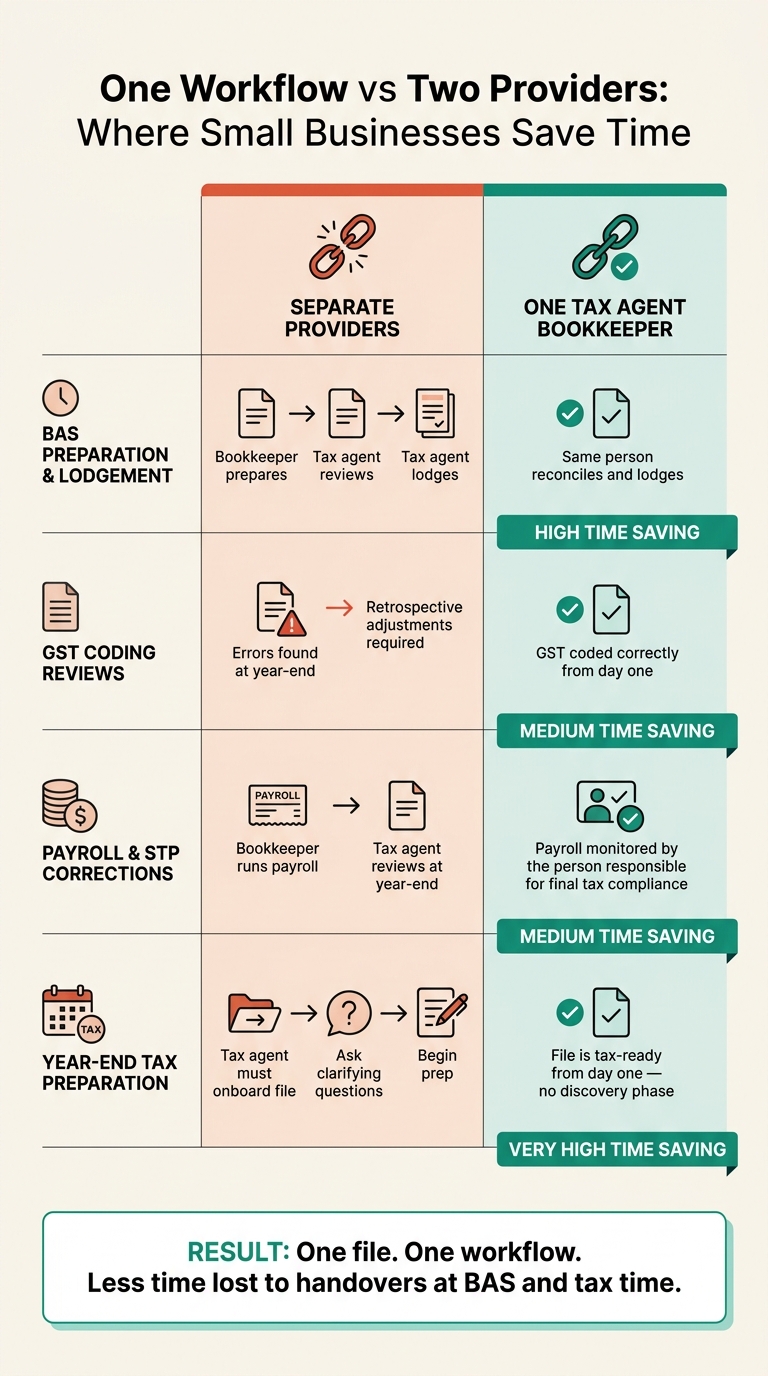
Bookkeeper + Tax Agent vs Separate Providers: Time & Workflow Comparison
A bookkeeper who is also a registered Tax Agent keeps Xero, BAS, and tax work in one workflow. That means the same file doesn’t need to bounce between providers. There’s no handover, no repeat explanations, and no need to walk someone new through old transactions. The business owner deals with one person from start to finish.
The time savings stand out most in BAS, payroll, and year-end tax work.
A registered Tax Agent can handle BAS, GST, PAYG, and income tax work in the same workflow. That matters because one person can deal with GST, PAYG, and income tax queries with the full file history already in view.
From multiple handovers to one workflow
With a combined setup, the same professional reconciles accounts each month, checks GST treatment as transactions are coded, prepares and lodges BAS, and then carries those records straight into year-end tax prep. In plain terms, there’s no discovery phase. No one has to stop and piece together what happened earlier in the year.
Separate providers vs one qualified professional: a side-by-side comparison
The difference is easiest to see when you line the two setups up next to each other.
| Task or process | Separate providers | One Tax Agent bookkeeper | Impact on time |
|---|---|---|---|
| BAS preparation and lodgement | Bookkeeper prepares; tax agent reviews and lodges. | Same person reconciles and lodges. | High saving: Cuts out back-and-forth between two professionals. |
| GST coding reviews | Errors found at year-end, requiring retrospective adjustments. | GST coded correctly from day one. | Medium saving: Stops year-end rework. |
| Payroll and STP corrections | Bookkeeper runs payroll; tax agent reviews at year-end. | Payroll monitored by the person responsible for final tax compliance. | Medium saving: Reduces STP finalisation errors at EOFY. |
| Year-end tax preparation | Tax agent must onboard the file and ask clarifying questions. | File is tax-ready; the person preparing the return did the bookkeeping. | Very high saving: Removes the discovery phase and shortens year-end lead times. |
These time savings show up most clearly in BAS, payroll, and EOFY work.
Where the time savings show up most in practice
BAS, GST checks and lodgement in Xero
The biggest time savings usually show up in BAS and GST work inside Xero. Most of the time lost on BAS doesn’t happen at lodgement. It happens during the quarter-end tidy-up.
If a registered Tax Agent reviews and fixes GST treatment in Xero as transactions are coded, the file stays BAS-ready through the quarter. That means fewer last-minute fixes, less backtracking, and a much smoother path to lodgement.
The same single-workflow setup also saves time in payroll, because the person doing the work isn’t stepping into a messy file at the end and trying to piece it all together.
Payroll, STP and PAYG checks
Payroll can chew up a lot of time when STP Phase 2 mapping and PAYG issues are left until late. STP Phase 2 mapping is especially sensitive. If it’s set up the wrong way, those errors flow straight into the BAS and year-end finalisation.
When the same person running payroll is also handling the final compliance process, those issues are more likely to get picked up during regular pay runs instead of months later. That’s a big deal. Fixing a problem as it happens is one thing. Untangling it after a quarter or at EOFY is another story.
PAYG withholding figures are also checked against the general ledger as part of that same workflow. So there’s no need for a separate reconciliation right before lodgement.
Year-end file review and tax return preparation
The biggest EOFY saving comes from having a file that’s already tax-ready.
By year-end, one person already knows the file, so tax prep can start straight away. Suspense accounts and unreconciled transactions are handled during the year instead of piling up. Director loan accounts and inter-entity transfers are tracked properly from the start, which cuts out the usual guesswork about whether a payment was personal or business-related.
That puts the file in shape for tax return preparation and cuts the time needed to get it done. It also means fewer follow-up questions at year-end and a faster EOFY handover.
Who benefits most and how The Priory Books and Tax supports this approach

Those time savings matter most for businesses with recurring BAS, payroll, or more involved reporting needs. The biggest gains tend to show up when bookkeeping, BAS, payroll, and year-end records all live in the same file. That setup is a strong fit for three main business types.
- Sole traders with quarterly BAS get fast relief because BAS and tax work stay in one workflow.
- Small companies running payroll avoid doing separate payroll-to-BAS reconciliations.
- Hospitality and multi-site businesses get better reporting, including inventory accounting, multi-site profit and loss reviews, and GST treatment for food and drinks.
Smaller businesses often get the most out of having one professional handle bookkeeping, BAS, and tax. As turnover grows, a more structured outsourced finance function usually starts to make more sense.
For businesses that want that support in one place, The Priory Books and Tax brings it together in a single workflow. The Priory Books and Tax is an Australia-wide online bookkeeping and tax service based in Mandurah. It combines bookkeeping, BAS and tax lodgements, payroll support, Xero setup, and catch-up bookkeeping in one workflow, with a secure online portal and direct messaging to a tax agent.
That means bookkeeping, compliance, and tax work move through the same file from start to finish. For hospitality and franchising, that matters even more. Multi-site reporting, franchisor KPI reporting, and award-compliant payroll can get messy fast, so keeping everything under one roof cuts down on back-and-forth.
The result is simple: one file, one workflow, and less time lost to handovers at BAS and tax time.
FAQs
Do I need a registered Tax Agent for BAS and tax work?
Yes. If BAS or tax work is done for a fee, it must be handled by a registered professional.
For BAS or IAS lodgement and GST advice, use a registered BAS Agent or Tax Agent. For income tax returns and broader tax planning, use a registered Tax Agent.
This isn’t just a box-ticking exercise. It helps with compliance, gives you consumer protection, and may also mean access to extended ATO lodgement deadlines.
When does a combined service save the most time?
A combined service saves the most time when your business needs a smooth link between day-to-day bookkeeping and tax compliance.
When one professional handles both, there’s less handover, less back-and-forth, and fewer errors caused by split records. That can make a big difference for BAS preparation and lodgement, GST coding, payroll and STP compliance, and year-end records for tax returns.
Can this setup help fix messy Xero or payroll records?
Yes. A bookkeeper who is also a registered tax or BAS agent can review and clean up messy Xero and payroll records.
They can spot and fix problems with GST coding, payroll mapping, and STP compliance. Then they can set things up the right way to help stop the same errors from happening again.
That means your records are more accurate, audit-ready, and in line with ATO requirements.