When should you find a bookkeepr?
When should you find a bookkeepr?
If your books are behind, your BAS or payroll is slipping, or you can’t tell what cash you’ve got free, it’s time to get a bookkeeper.
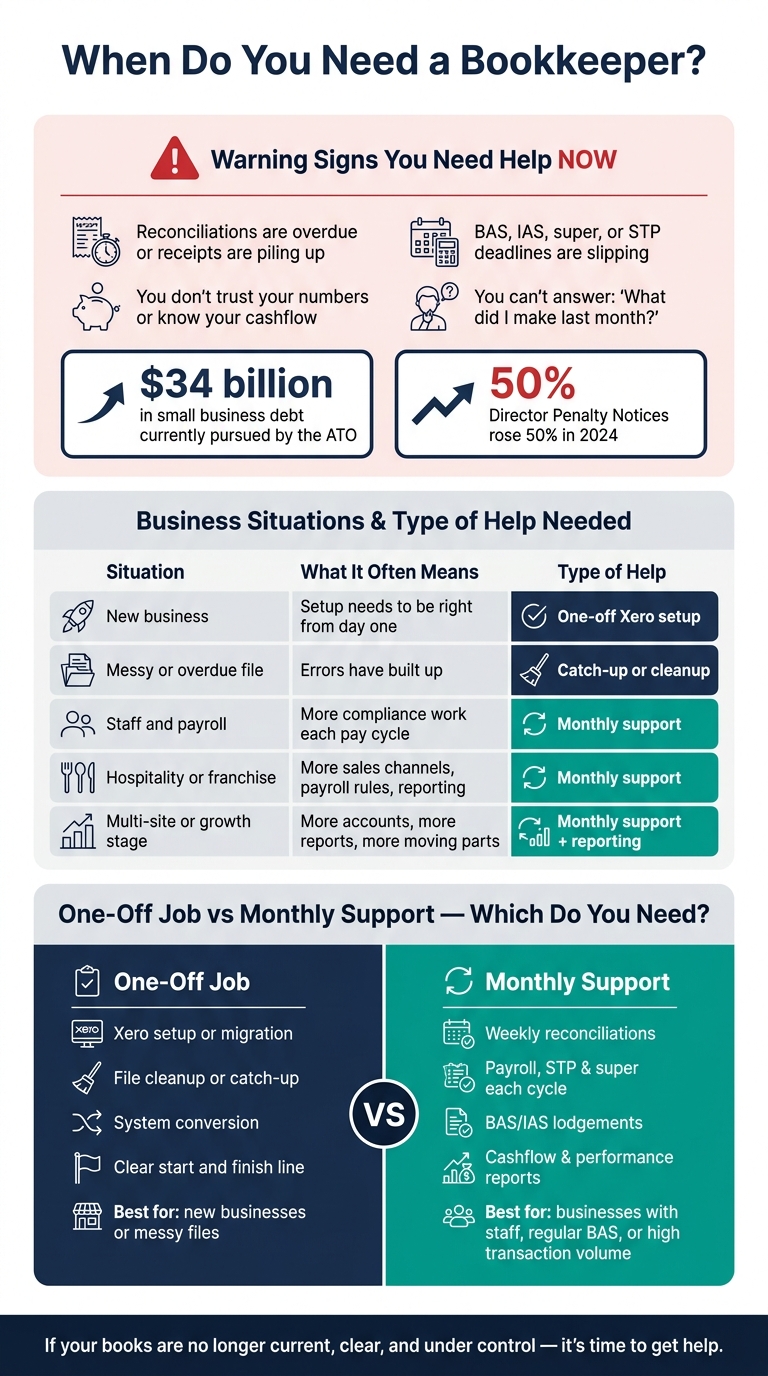
I’d keep it simple: this decision is usually about workload and compliance, not just turnover. A business can be small by revenue and still have a lot to deal with if it has payroll, GST, STP, daily sales reconciliations, or more than one site. And with the ATO chasing about $34 billion in small business debt, while Director Penalty Notices rose 50% in 2024, getting behind can get ugly fast.
Here’s the short version:
- Get help now if reconciliations are overdue, receipts are piling up, or month-end keeps drifting
- Bring in support if BAS, IAS, super, payroll, or STP Phase 2 feels shaky
- Don’t wait if you don’t trust your reports or can’t answer basic cashflow questions
- Use a one-off job for Xero setup, cleanup, conversion, or catch-up work
- Use monthly support if you have staff, regular lodgements, high transaction volume, or more than one location
- Act earlier if you run hospitality or a franchise, where payroll rules, merchant payouts, and site reporting add more moving parts
A bookkeeper can take over the jobs that often drag owners off track: reconciliations, payroll, super, BAS/IAS, Xero setup, file repair, and monthly reporting. If doing the books is costing you time, sleep, or clean numbers, that’s usually your answer.
| Situation | What it often means | Type of help |
|---|---|---|
| New business | Setup needs to be right from day one | One-off Xero setup |
| Messy or overdue file | Errors have built up | Catch-up or cleanup |
| Staff and payroll | More compliance work each pay cycle | Monthly support |
| Hospitality or franchise | More sales channels, payroll rules, reporting | Monthly support |
| Multi-site or growth stage | More accounts, more reports, more moving parts | Monthly support + reporting |
Put simply: if your books are no longer current, clear, and under control, I’d stop trying to push through it alone.
When Do You Need a Bookkeeper? Signs, Stages & Support Types
E3: Hiring a Bookkeeper: When to Act and What to Ask
sbb-itb-98a37a2
Warning signs you need a bookkeeper now
When bookkeeping stops staying current, the signs usually show up fast. And once they do, things can get messy in a hurry.
You are behind on reconciliations or need catch-up bookkeeping
The clearest sign is a backlog: months of uncoded bank transactions, piles of unprocessed receipts, and a file that is no longer current. At that point, BAS, IAS, and super lodgements can turn into a last-minute scramble.
Once the file falls behind, every deadline gets harder to hit.
BAS, GST, payroll, or STP deadlines are slipping
If you have received a reminder from the ATO about an overdue BAS, take it seriously. The ATO is currently pursuing approximately $34 billion in debt owed by small businesses, and Director Penalty Notices (DPNs) jumped 50% in 2024 compared to 2023. When tax and super go unpaid, the risk can land on the business owner personally.
If you cannot say with confidence that payroll, STP, or super are correct and lodged on time, it is time to bring in help.
Even when deadlines are still being met, there is another issue that often gets missed: poor visibility.
You do not trust your numbers or know your cashflow position
Your bank balance only shows what is in the account today. It does not tell you what is set aside for GST, which invoices are still unpaid, what wages are due, or which bills are due next week.
If you cannot clearly answer simple questions like what your business made last month, how much GST you owe, or whether you can cover wages next week, your books are not doing their job.
Business stages when a bookkeeper adds the most value
A lot of businesses bring in a bookkeeper at a turning point, before the file starts to drift. Others get help much earlier, at setup, migration, or during a growth patch.
Setting up Xero for the first time

Setting up Xero can look easy at first glance. But the setup needs to be right from day one. The chart of accounts, bank feeds, GST codes, payroll categories, STP Phase 2, and receipt capture all need to be configured properly. One wrong GST code can run through BAS, payroll, and reports for months.
A BAS agent or Xero specialist can set up the file, connect bank feeds, build rules, and show you or your staff how to use it. If the file is already live, the next point where many businesses call for help is during a conversion or clean-up.
Converting from another system or cleaning up a messy file
Moving from another system, from spreadsheets, or from a messy Xero file is often when a business brings in a bookkeeper mid-stream. The main issue is simple: errors pile up. The longer you keep working in a file with miscoded expenses, duplicate entries, or personal spending mixed in with business transactions, the messier it gets and the harder it is to fix.
A proper conversion or file repair usually means:
- mapping past data into Xero the right way
- fixing coding issues
- separating personal spending from business transactions
- rebuilding a reporting structure you can trust
The point is not just to tidy the file. It’s to get reports that make sense and can be relied on.
When headcount, locations, or transaction volume start growing
As soon as a business adds more people, more sites, or more volume, bookkeeping gets harder fast. More staff, more locations, and more transactions mean more payroll, more reconciliations, and more reporting. A second employee means another pay run, more super obligations, and extra STP reporting. A second location can mean more bank accounts, more merchant terminals, and more supplier invoices to process. Each extra layer makes DIY bookkeeping tougher to keep up without mistakes slipping in.
Businesses earning between $1 million and $5 million often hit a transition phase where DIY methods and “good enough” accounting start becoming a liability.
Specific triggers for hospitality and franchise businesses
Hospitality and franchise operators tend to feel bookkeeping strain sooner. The reason is pretty simple: more transactions, tighter cut-off dates, and more reports to pull together. In cafés, restaurants, and franchise groups, the warning signs usually show up earlier than they do in other businesses.
High-volume sales and merchant reconciliations
Busy cafés and restaurants take payments from all over the place: POS, cash, cards, delivery platforms, and merchant terminals. The messy bit is that payouts, fees, and surcharges often don’t line up neatly with what the POS shows.
If daily sales, payouts, and bank deposits don’t reconcile, the file already has errors in it. That kind of mismatch is a clear sign you need bookkeeping support.
And once sales and payouts stop matching, payroll is often the next area to come under strain.
Award and penalty-rate payroll, casual staff, and STP obligations
Hospitality payroll is rarely simple. Casual staff, penalty rates, split shifts, and award rules all create room for mistakes. On top of that, STP Phase 2 adds another lodgement job.
Payroll errors in hospitality can snowball fast. If lodgements are late or incorrect, that’s usually the point where bringing in help stops being optional.
Franchise reporting then adds one more layer to the day-to-day bookkeeping load.
Franchisor reporting and multi-site visibility
Many franchise agreements require regular reporting on sales, royalties, and KPIs. If your coding isn’t consistent, or you’re waiting until the end of the quarter to pull the numbers together, you’re already behind.
Each location needs its own reconciliations, payroll, and reporting. A bookkeeper can keep coding consistent across sites and produce monthly site reports.
What a bookkeeper can take over and how to choose the right support
Tasks a bookkeeper can handle for you
Once those warning signs show up, the next step is pretty simple: work out what a bookkeeper can take off your plate.
That usually starts with the core jobs - compliance, reconciliations, payroll, and super. But it often goes further than that. A bookkeeper can also set up or convert your Xero file, sort out catch-up bookkeeping, and put receipt capture in place so you spend less time keying things in by hand.
If you need more than just staying on top of compliance, a bookkeeper can also help with cashflow reporting and monthly performance reports. That kind of visibility makes day-to-day decisions a lot easier.
When a one-off job is enough and when monthly support makes sense
The right support depends on where your business is right now. In most cases, it comes down to two options: a one-off cleanup or monthly support.
A one-off project works best for a specific job with a clear finish line. Think Xero setup, moving across from another system, or clearing a backlog of unreconciled transactions. These are fixed jobs, not long-term support.
Monthly support makes more sense for businesses with employees, regular BAS obligations, or lots of transactions. If you need weekly reconciliations, payroll runs, and up-to-date cashflow visibility month after month, that’s usually the better fit.
Here’s a simple way to match the service to your situation:
- New business or messy file: one-off setup, conversion, or catch-up
- Employees and regular BAS: monthly payroll, STP, BAS/IAS, and super
- Growing or multi-site: monthly support plus cashflow reporting
Conclusion: The clearest signs it is time to get help
Once you know the scope, the call becomes much easier: fix the file once, or keep support in place each month.
If reconciliations are behind, BAS is slipping, cashflow is unclear, or your Xero setup still isn’t finished, it’s time to get help now. Hospitality and franchise operators often need support earlier because transaction volume, payroll rules, and multi-site reporting can pile up fast.
FAQs
How much does a bookkeeper usually cost?
Bookkeeping costs are often charged as a flat monthly fee, which makes pricing easier to plan for. You know what you're paying each month, without surprise hourly charges or hidden add-ons.
The price will vary depending on what your business needs, but flat-rate packages may include services like bank reconciliations, payroll processing, and BAS preparation. That means you can get expert financial help without paying for a full-time employee.
Can I hire a bookkeeper just to catch up my books?
Yes. You can hire a bookkeeper to catch up your books.
They can sort out past reconciliations, fix compliance issues, and work through backlogs in payroll, account reconciliations, or ATO duties. That helps clean up your financial records, cuts down your admin load, and keeps your business on the right side of compliance.
What should you prepare before engaging a bookkeeper?
Before you bring in a bookkeeper, get clear on the kind of help you need and how often you’ll need it, whether that’s weekly, fortnightly or monthly.
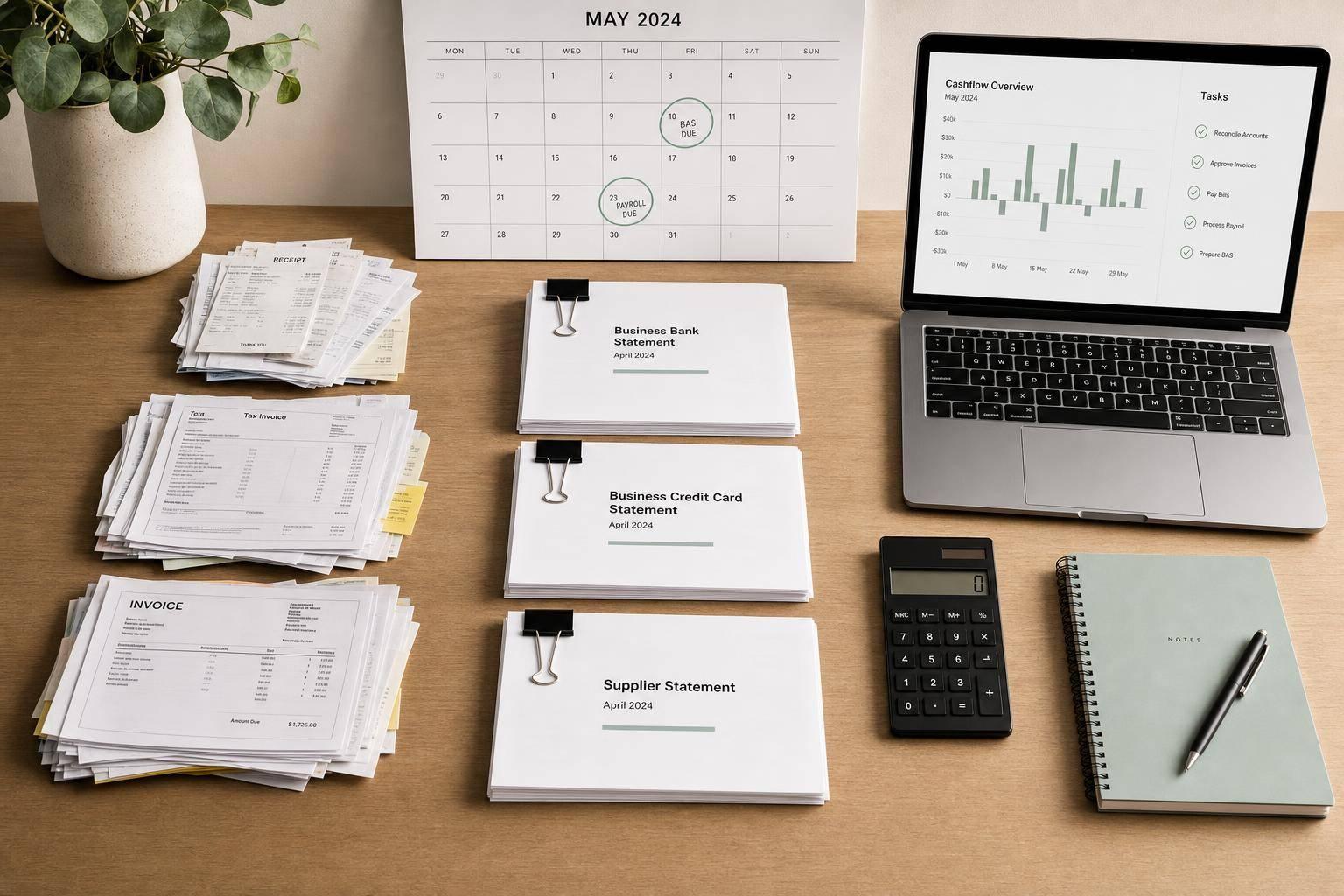
It also helps to have your paperwork in one place. Pull together your receipts, invoices, bank statements and credit card records. If you already use Xero, keep your login details handy. If not, make a note of whether you need help setting it up or moving over from another system.
You should also be ready to talk through a few practical things, like:
- where work tends to pile up
- your growth goals
- compliance jobs such as payroll or BAS