Monthly Management Reports in Xero: Small Business Guide
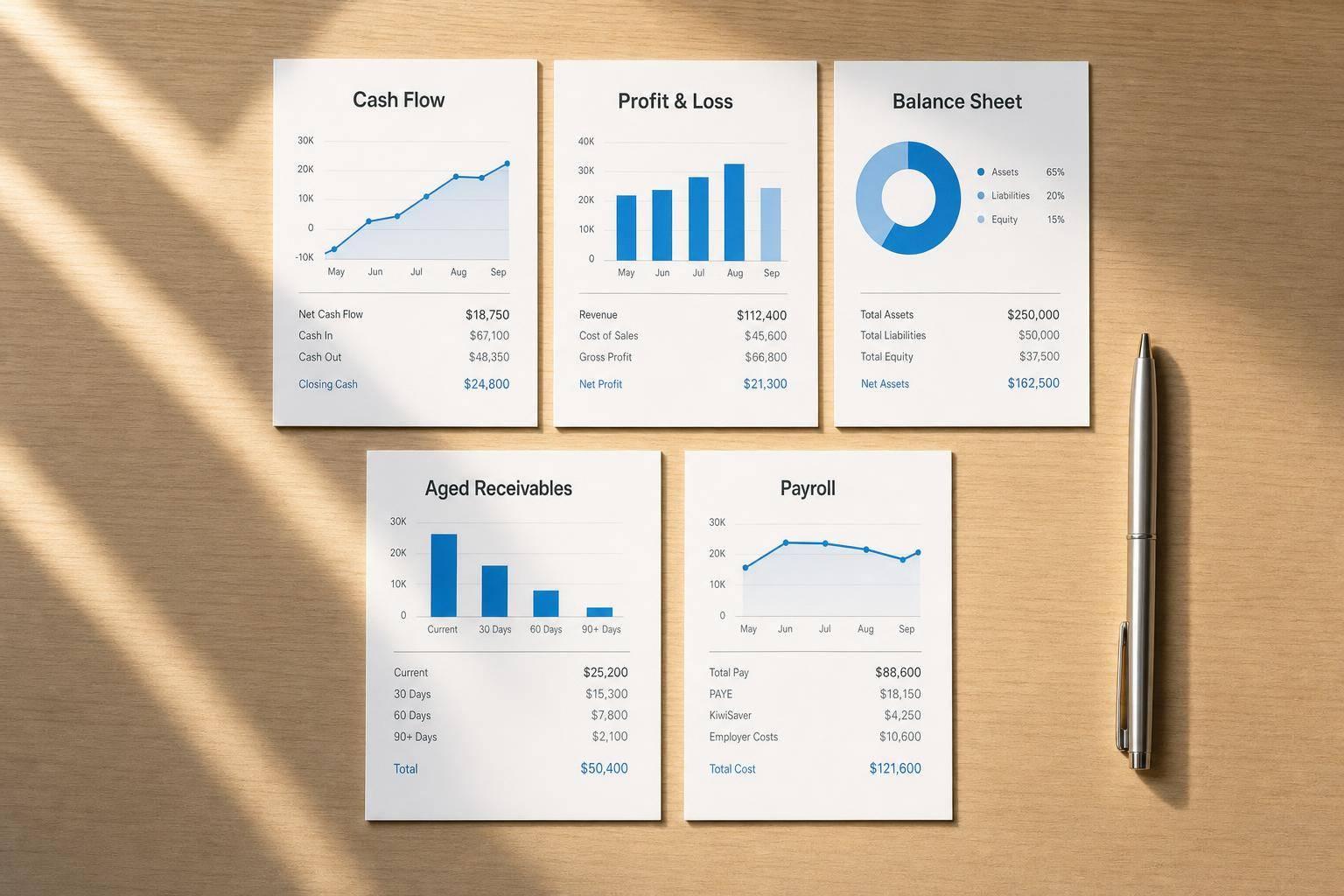
Monthly Management Reports in Xero: Small Business Guide
If I check five Xero reports each month within 10 days of month-end, I can spot cash gaps, tax pressure, and wage issues before they get out of hand.
For most Australian small businesses, a monthly report pack should cover Profit and Loss, Cash Flow, Balance Sheet, Debtor Summary, and Payroll Totals. That gives me one clear view of profit, bank cash, unpaid invoices, tax bills, and wages without jumping between screens.
Here’s the short version:
- Profit and Loss shows if the business made money
- Cash Flow shows where money moved
- Balance Sheet shows what the business owns and owes
- Debtor Summary shows which customers still need to pay
- Payroll Totals shows wages, super, and PAYG withholding
A monthly review helps me focus on three things fast:
- collections if profit is up but cash is not
- pricing if margins are getting thinner
- tax timing if GST, PAYG, or super are stacking up
One fact matters here: if invoices sit past 60 days, cash pressure often follows. And if payroll costs keep climbing as a share of sales, rostering or staffing may need a close look.
If I keep the month-end close the same each month, the reports become much easier to read and act on. That is the whole point of the pack: not more admin, but a simple monthly check that helps me decide what to do next.
Create Custom Report Packs in Xero

sbb-itb-98a37a2
The 5 reports to include in a monthly Xero pack
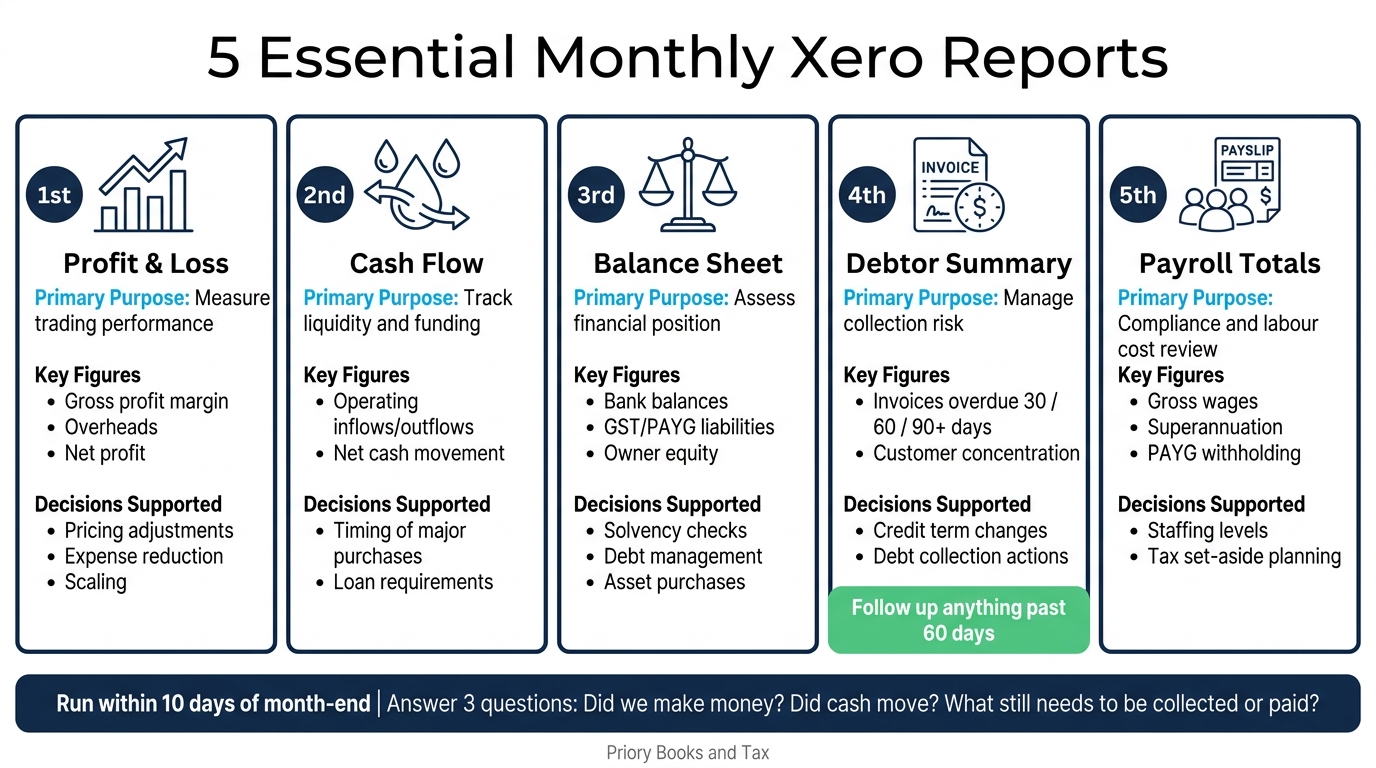
5 Essential Monthly Xero Reports for Australian Small Businesses
A monthly Xero pack should answer three simple questions: did the business make money, did cash move, and what still needs to be collected or paid? That’s why it pays to keep the pack tight. These five reports cover profit, cash, debtors, liabilities, and payroll costs.
Read the pack in this order: profit and loss first, then cash flow, balance sheet, debtors, and payroll.
| Report | Primary Purpose | Key Figures to Review | Decisions Supported |
|---|---|---|---|
| Profit and Loss | Measure trading performance | Gross profit margin, overheads, net profit | Pricing adjustments, expense reduction, scaling |
| Cash Flow | Track liquidity and funding | Operating inflows/outflows, net cash movement | Timing of major purchases, loan requirements |
| Balance Sheet | Assess financial position | Bank balances, GST/PAYG liabilities, owner equity | Solvency checks, debt management, asset purchases |
| Debtor Summary | Manage collection risk | Invoices overdue by 30/60/90+ days, customer concentration | Credit term changes, debt collection actions |
| Payroll Totals | Compliance and labour cost review | Gross wages, superannuation, PAYG withholding | Staffing levels, tax set-aside planning |
Profit and loss: trading performance for the month
Start with the P&L. It shows sales, cost of sales, gross profit, overheads, and net profit. A month-on-month view helps you spot whether margins are holding up or starting to slip.
If you sell jobs or projects, Xero’s tracking can help you see where profit is actually being made. That matters, because strong sales on paper don’t always mean each job is pulling its weight.
Cash flow: cash movement and short-term funding needs
Accounting profit does not always mean cash in the bank. That’s the trap. The cash flow report breaks down operating inflows and outflows, so you can see where cash is going and whether timing gaps are putting pressure on the business.
Monthly cash flow planning matters because BAS and super payments can fall due before every sale turns into cash. After that, check the balance sheet to see whether those cash pressures are building up as liabilities.
Balance sheet: assets, liabilities and owner equity
The balance sheet gives you a snapshot of the business’s financial position on the last day of the month. It covers bank balances, fixed assets, trade creditors, GST and PAYG obligations, loans, and owner equity.
Use it as a month-end solvency check. If GST or PAYG liabilities keep growing, that’s a red flag. It can mean tax bills are stacking up without enough cash being set aside to pay them.
Debtor summary: overdue invoices and collection risk
The aged receivables report shows unpaid customer invoices by age, usually 30, 60, and 90-plus days. This is where collection risk becomes easier to spot. One large debtor can put cash flow under strain fast, so customer concentration matters.
Anything sitting beyond 60 days needs active follow-up. If debtors look clean but cash is still tight, the next places to look are often payroll or tax liabilities.
Payroll totals: wages, super and PAYG withholding
The payroll summary covers gross wages, superannuation, and PAYG withholding for the month. It also shows payroll liabilities due soon, including super and PAYG withholding.
If the super liability on the balance sheet keeps growing month by month and isn’t being cleared, that needs attention fast.
How to prepare the reports in Xero each month
A clean month-end close is what makes the pack reliable. Finish the close before you run a single report.
Complete the month-end close first
Work through the close in the same order each month. Reconcile bank and credit card accounts, enter unpaid supplier bills, finalise payroll and STP reporting, check that superannuation and PAYG withholding match the amounts due, review GST coding across transactions, and check debtor balances against issued invoices.
Once the books are closed, run the reports using the same month-end date range.
Generate and save a consistent reporting format
Run each report from the first day to the last day of the month. Using the same period each time keeps month-to-month comparisons like for like.
Save the five reports as custom layouts and reuse the same pack each month. A consistent format makes it easier for the reviewer to compare results over time.
With the pack closed and saved, the next step is to read what changed in profit, cash and liabilities. That same pack makes the review faster and the trends easier to spot.
How to read the monthly pack and act on it
Once the month is closed and the pack is saved, use it to test three things: profit, cash, and liabilities. The point isn't just to log last month's numbers. It's to work out what needs attention this month.
Key checks after reviewing profit, cash and balance sheet
Start with a simple test: is accounting profit turning into money in the bank?
If profit is up but bank cash isn't, chase overdue invoices first. That's often the first place the gap shows up.
Next, check whether gross margin has shifted. If revenue stayed flat but margin got thinner, supplier costs may be climbing faster than your prices. In that case, review pricing now before margin slips again.
Then look at the balance sheet and see whether liabilities are piling up faster than cash reserves. If GST, PAYG or super liabilities are growing, set cash aside now and clear those balance sheet items on schedule with professional tax support.
Those checks usually point to one of three issues:
- collections
- pricing
- tax timing
What debtor and payroll numbers usually signal
If profit and cash don't look right, check debtors and payroll next.
Rising overdue invoices are often an early sign of cash flow pressure. Follow them up sooner so the debt doesn't keep ageing.
On the payroll side, watch the ratio of wages to revenue. If payroll is creeping up as a share of total income, review rostering when payroll is rising faster than revenue. Also clear super and PAYG on schedule. Rising payroll liabilities usually point to a cash-flow problem.
When to get help with monthly Xero reporting
If your monthly pack keeps landing late or the numbers stop tying out, it’s time to bring in help.
When monthly Xero reports start slipping, bookkeeping support is no longer a nice extra. It’s part of the reporting process. The clearest signs are a late month-end close, payroll getting harder to manage, or small business tax duties that you can’t track with confidence. Once those issues start stacking up, your reports go stale before you’ve even had a chance to read them. At that point, the problem isn’t just the numbers. It’s the process behind them.
If your books are already behind, catch-up bookkeeping can bring everything back up to date fast. The Priory Books and Tax can help small businesses keep Xero month-end close, payroll, BAS and cash flow reporting current.
The goal is simple: keep the monthly pack current, reliable, and ready for action.
Conclusion: Build a repeatable monthly reporting rhythm
After month-end close, the aim is to have a reporting pack you can rely on every month. For most Australian small businesses, five reports - profit and loss, cash flow, balance sheet, debtor summary, and payroll totals - give a clear view of where the business stands.
That monthly rhythm matters for another reason too. The same pack helps support BAS and payroll timing. Monthly reporting suits most small businesses because it helps keep BAS, super, PAYG withholding and STP reporting on track without piling on extra admin.
Still, the pack is only as good as the process behind it. If month-end close is done the same way each time, clean Xero data turns into action - not just a stack of reports.
Regular reconciliations and a fixed month-end close help keep Xero data clean, so the pack reflects the month itself instead of a scramble of last-minute corrections.
Keep the rhythm fixed, and use the numbers each month.
FAQs
How do I know if my month-end close is accurate?
In Xero, a clean month-end close starts with fully reconciled bank accounts. You also need tidy, up-to-date records, with bank reconciliations done on a regular basis and purchases and bills processed the right way.
When your bookkeeping is in good shape and you use Xero’s real-time reports, you can trust that your management reports show your business’s actual financial position.
What should I do if profit is up but cash is tight?
It usually means there’s a gap between the income you’ve recorded and the cash that has actually landed in your account.
Start by checking your debtor summary in Xero for overdue invoices, then chase any outstanding payments.
It also helps to review your cash flow statement and compare your budget with actuals. That can show whether cash is getting tied up in inventory, capital spending, debt repayments, or unexpected expenses.
When should I get help with monthly Xero reporting?
Get professional help with monthly Xero reporting when you’re ready to stop juggling the bookkeeping yourself or passing it to an already stretched team member.
It can also make sense to bring in support if you want clean accounts from day one, need a hand with award-compliant payroll, or want a better Xero setup with the right app integrations.
The Priory Books and Tax provides Xero-based bookkeeping, BAS lodgements, and cash flow forecasting.